How many range balls do pros hit before a round? What the 2026 Masters data actually shows
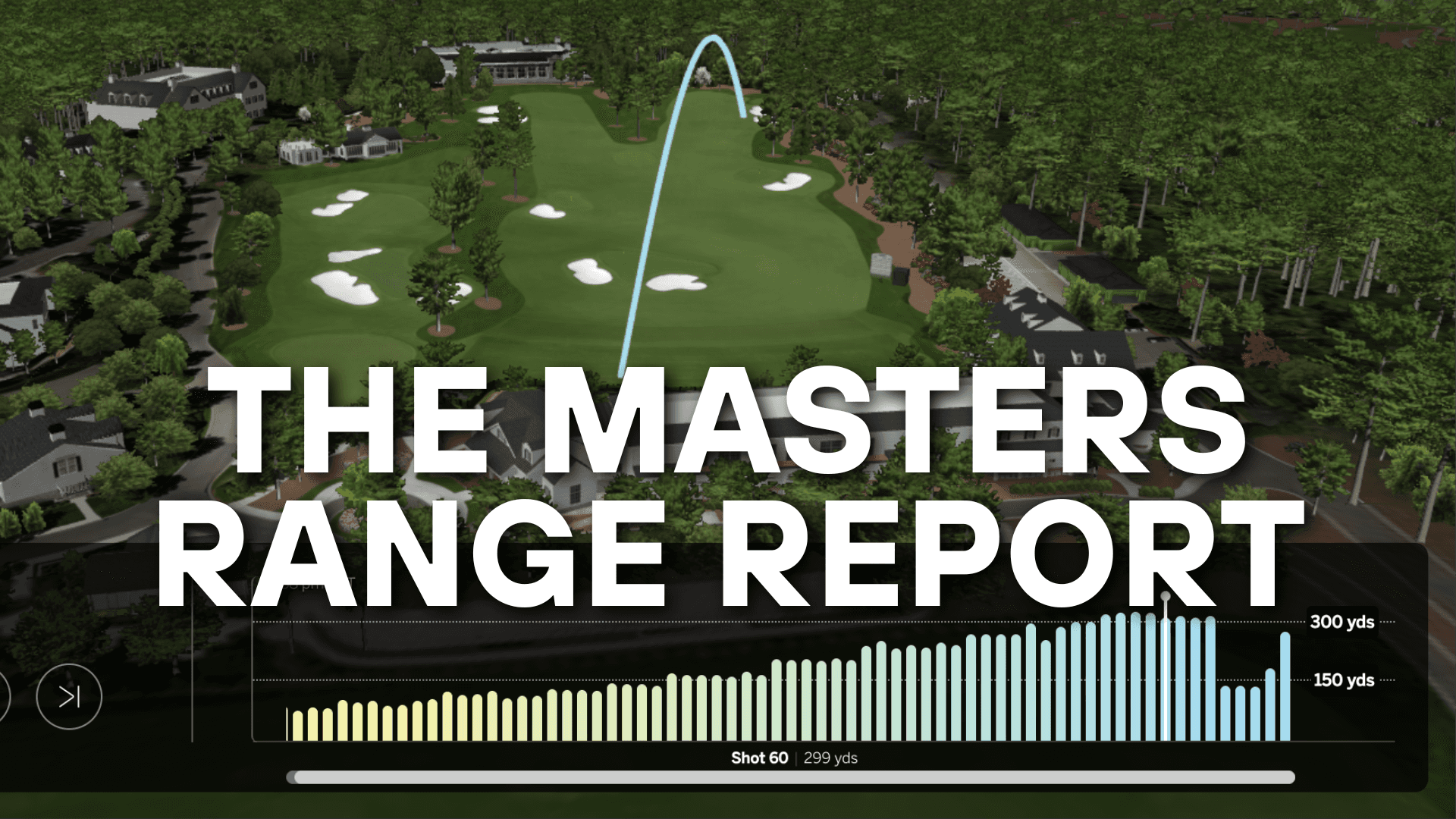
A data analysis of every range shot tracked at Augusta National last week, cross-referenced with the final leaderboard.
The short answer
Every player in contention at the 2026 Masters hit between 33 and 54 range balls before teeing off in the final round. Justin Rose hit 33. Rory McIlroy, who won, hit 54. The 11 players who finished in the top 10 averaged 41 warm-up balls.
Across the full week, the top 11 finishers averaged 432 total range shots. The nine players who hit the most range balls during practice rounds averaged 466 shots in those three days alone, and none of them finished better than T9.
The headline: at the elite level, more practice volume did not predict better performance. The opposite was directionally true.
The deeper finding, and the one I want to spend most of this post on: this is not a one-week observation. The Masters data lines up with 50 years of motor learning research, with strokes gained data on where amateur scoring actually comes from, and with a separate ball flight study I ran two months ago showing that the range itself is partially broken as a practice tool.
The post is long because the topic deserves it. If you want the bottom line, the short answer above is the bottom line.
Methodology
Every shot total in this post comes from the official Masters Range Tracker, which logged every range shot for 91 players across all seven days of tournament week (Monday, April 6 through Sunday, April 12, 2026). I matched each player to their final leaderboard position and to their Sunday tee time. The full dataset is available on request.
A note on what the tracker measures: it counts all range shots in a calendar day. It does not separate pre-round warmup from post-round practice. For Sunday specifically, this matters less because most contenders teed off in the afternoon, and the data is mostly pre-round. For weekday totals, the numbers reflect the full day.
I'm calling out this limitation because it's the first thing a careful reader would push back on, and I want it on the table before any of the analysis.
How many range balls did the winner hit at the 2026 Masters?
Rory McIlroy hit 437 range balls across the full tournament week, including 54 on Sunday morning before the final round. His Monday through Wednesday practice volume was 170 balls total, which was the second lowest of any top 11 finisher.
For comparison, Patrick Cantlay finished T12 and hit 1,032 range balls across the week. That is 595 more practice shots than the champion, for a finish seven strokes worse.
How many range balls did the top 10 finishers hit during the tournament?
Across Monday through Sunday, total range shots for the final top 10:
McIlroy (1st): 437 Scheffler (2nd): 433 Hatton (T3): 344 Henley (T3): 421 Rose (T3): 360 Young (T3): 430 Morikawa (T7): 320 Burns (T7): 438 Homa (T9): 776 Schauffele (T9): 321
The average is 428 shots. Strip out Homa, who is a known high-volume player, and the average drops to 389.
Did the players who practiced the most finish well?
No. The nine players who hit the most range balls during the practice rounds (Monday through Wednesday) and their final finish:
Gotterup: 532 practice shots, T24 finish Cantlay: 491, T12 Griffin: 481, T33 Noren: 481, T30 Reitan: 473, T41 Clark: 458, T21 Homa: 450, T9 Stevens: 441, T24 Kitayama: 439, 51st
One top 10 finish out of nine players. Eight of the nine finished outside the top 20.
For context, the players who hit the fewest practice balls and still made the cut included Morikawa (146 shots, T7), Hatton (185, T3), Schauffele (193, T9), and McIlroy (170, 1st).
What does the Sunday warmup data show?
Sunday at Augusta produced the cleanest pattern in the entire week. Range shots for every player who teed off in the final 13 groups (the contenders):
McIlroy: 54 Young: 45 Lowry: 37 Burns: 39 Day: 39 Rose: 33 Li: 35 Scheffler: 42 Henley: 40 Cantlay: 68 Morikawa: 42 Reed: 52 Knapp: 36 Griffin: 48
The range is 33 to 68. Strip Cantlay, who was visibly grinding for something all week, and the band tightens to 33 to 54.
For comparison, players who teed off early on Sunday because they were out of contention often hit almost nothing. Charl Schwartzel hit three balls. Corey Conners hit three. Brian Campbell hit two. Sungjae Im hit five.
The pattern: when there was something to play for, contenders warmed up in a tight 33 to 54 ball window. When there was nothing to play for, players warmed up minimally and went to play.
Is there a statistical correlation between practice volume and finish position?
Across all 57 players who made the cut, the correlation between Monday-Wednesday practice volume and final finish position is 0.08. That is essentially zero.
This is important. The data does not prove that more practice causes worse golf. It shows that the players who happened to win practiced less than the field average, and the players who practiced the most happened to finish mid-pack. Those are descriptive findings, not causal claims.
What the data does support is a narrower statement: at the very top of the leaderboard, the winning players were efficient with their range time. None of them used the range to grind through volume. All of them used Sunday morning to warm up, not to fix.
Why the Masters pattern is not surprising: 50 years of motor learning research
The reason the volume pattern at Augusta deserves a post and not just a tweet is that it lines up with a body of research most golfers have never been shown.
In 1979, Shea and Morgan ran a now-classic experiment on motor skill learning. They had two groups practice the same set of movements. One group practiced "blocked" (the same skill repeated over and over before moving on). The other practiced "random" (the skills mixed up, never the same one twice in a row).
During practice, the blocked group looked dramatically better. They were faster, more accurate, more confident. The random group looked worse, less coordinated, more frustrated.
Then both groups were tested two weeks later.
The random group beat the blocked group by a wide margin on the retention test. They had learned the skill. The blocked group had learned how to repeat it in that exact context, which is not the same thing.
Fifty years of follow-up research has replicated this finding across sports, music, surgery, military training, and yes, golf. The blocked-vs-random distinction is one of the most robust findings in skill acquisition science.
What does this have to do with the Masters?
Most range practice is blocked practice. You stand in one spot, you hit the same club to the same target, you repeat. It feels like it's working because the contact gets cleaner inside the session. But the research says that feeling is misleading. The golf you actually play on the course is random practice. Different lies, different yardages, different clubs, different shot shapes. Every single shot is a fresh problem.
Cantlay hitting 1,032 balls in a week probably included a lot of blocked practice. McIlroy hitting 437 almost certainly included less. The Masters data is one tournament, but it's the kind of one tournament that maps cleanly to the science.
The broader principle: practice that feels productive is often the practice that transfers least.
What the strokes gained data says about where you should actually be spending range time
The other reason most amateur range practice is broken is that the time spent on each part of the game does not match where strokes actually come from.
Across handicap levels, the strokes gained breakdown averages roughly:
Approach shots: 37% of scoring, Putting: 28%, Off the tee: 20%, Around the green: 15%
If you watch the average weekend golfer at the range, the breakdown is closer to:
Driver: 40% Long irons: 25% Mid irons: 20% Wedges: 10% Putting: 5% (often zero) Around the green: 0%
The most practiced category for amateurs (driver) is the third most important for scoring. The second most important category for scoring (putting) is barely practiced at all. Around the green, which accounts for 15% of scoring, gets zero range time by definition because the range isn't built for it.
So even before we get to volume vs intent, there's a category mismatch. A weekend golfer hitting 100 range balls is hitting them mostly in categories that account for 60% of scoring at most, while ignoring the 43% of scoring that lives on the green and around it.
When the Masters grinders hit 500 range balls in a practice day, they're at least hitting them as professionals who already have putting and short game systems. When a 15 handicap hits 100 range balls before a round, they're skipping the practice that would actually move the needle on their score, then getting tired before they tee off.
What the GCQuad data revealed about the range itself
In February, I ran a launch monitor study comparing a Titleist Pro V1 against a typical range ball, hit on the same mat with the same club by the same player. Same swing, same conditions, same launch monitor.
The lob wedge result was the headline. The range ball and the Pro V1 produced almost identical carry distances. But the total distance was 21 yards apart. Spin was 2.5 times higher with the Pro V1.
What that means in practice: when you hit a 60-yard lob wedge on the range, and it lands on the 60-yard target, you think you've grooved a 60-yard shot. On the course, with your gamer ball, that same swing carries 60 yards but releases out to 75. You've practiced a shot you don't actually have.
The longer clubs were less dramatic but still meaningful. Range balls fly 5 to 10 yards shorter than premium balls and spin meaningfully less. Players use this as proof that they hit the ball further on the course, but the deeper issue is calibration. Every yardage you've internalized at the range is wrong by a few yards in either direction.
So when we put the Masters data alongside the ball flight data, the picture for amateur range practice gets harder to defend. Most of the practice is blocked practice. Most of it is in the wrong scoring categories. And the ball doing the work is not the ball you'll play with. Volume on top of all three of those things isn't fixing anything. It's compounding the misalignment.
Why this maps to course management before technique
Scott Fawcett, who built the DECADE course management system, has been making a related argument for years. He believes that for roughly 95% of recreational golfers, course management and shot selection produce more strokes saved than technique work, and that most amateurs invert this.
The Masters data provides an indirect version of his point. The players at the top of the leaderboard at Augusta do not have technical issues to solve at the range. They have a course to play. Sunday warm-up is not a tune-up of the swing. It's a check-in with the body.
For a recreational golfer, the equivalent is even sharper. You almost certainly cannot fix your swing at the range in the half hour before a round. What you can do is wake up your body, calibrate your distances roughly, and walk to the first tee with a clear plan for which clubs you'll hit and which targets you'll commit to.
This is the warmup the Augusta contenders gave themselves. 33 to 54 balls. No technical fixing. Just a body check and a transition to the course.
What recreational golfers can take from this
Three findings translate cleanly to weekend play.
The warmup ceiling. If 50 range balls is enough for a player walking to the first tee at Augusta National with a green jacket on the line, it is enough for a Saturday morning round at any course. The contenders' tight 33 to 54 ball band is a useful anchor for any pre-round warmup. Hit a wedge, work up through the bag, finish with the club you'll hit on the first tee. Twenty minutes. Then putt. Then go play.
The cost of grinding bad rounds. The data showed that pros who knew their tournament was over did not punish themselves with extra range time. They warmed up minimally and played. Recreational golfers tend to do the opposite, hitting more balls when scores are high. The Masters data suggests this instinct is backwards. If a round goes badly, the answer is not 200 more balls that night. The answer is to figure out which two shots cost you the most strokes and design your next short practice session around fixing those.
Volume is not effort. Cantlay hit 1,032 balls. McIlroy hit 437. Both were trying to win. The difference was not work ethic. It was what each shot was for. McIlroy's 437 had a job. A meaningful chunk of Cantlay's 1,032 was almost certainly searching, not training.
For a deeper rebuild of how you practice, consider three things:
Match your time to the strokes gained breakdown. If approach shots and putting account for 65% of your scoring, those should be 65% of your practice time. For most amateurs, the easiest version of this is a weekly 15 minute putting session and a weekly short game session, both of which most people skip entirely.
Make your practice random, not blocked. Instead of hitting 20 seven irons in a row, alternate clubs and targets every shot. It will feel worse. The research says it is dramatically more transferable.
Practice with the ball you play, when you can. The range ball problem is not solvable for most golfers, but it is worth knowing about. Every distance you've calibrated on the range is approximate at best. Trust your on-course yardages, not your range yardages, when you're making club decisions.
Sources and dataset
Range shot totals: Masters Range Tracker, Masters.com, April 6-12 2026. Final leaderboard: Masters.com. Sunday tee times and pairings: PGA Tour, April 11 2026. Strokes gained category weights: derived from public strokes gained datasets, averaged across handicap levels. Block vs random practice research: Shea, J.B. and Morgan, R.L. (1979), "Contextual interference effects on the acquisition, retention, and transfer of a motor skill." Journal of Experimental Psychology: Human Learning and Memory, 5(2). Ball flight comparison: GCQuad launch monitor study, Play Ready Golf, February 2026. Course management framework: DECADE Golf, Scott Fawcett.
If you want the full player-by-player Masters dataset, reply to this post or email isaak@playreadygolf.com.